
Brand differentiation: delivering on brand promises
Most businesses want to be different yet few actually are. Spend ten minutes looking at websites from pretty much any sector and you’ll see the same claims popping up again and again. Better service, better quality, innovative, customer-focused, passionate about what they do…. the list goes on. Occasionally somebody will be “refreshingly different”, which is generally a fairly reliable sign that they aren’t.
That’s the problem with brand differentiation. Saying you’re different is easy. Giving people a genuine reason to believe it is considerably harder. The brands that really stand out tend to have something of substance underneath the marketing, another dimension that backs up their brand promise. Which is usually something a competitor can’t replicate or rip off on Tuesday afternoon by changing a few words on its homepage.
Patagonia, Tony’s Chocolonely and Ryanair couldn’t be much more different from each other in terms of either product or approach yet all three have clearly worked out what they want to stand for and built it into their messaging.
Patagonia – brand differentiation through making a difference
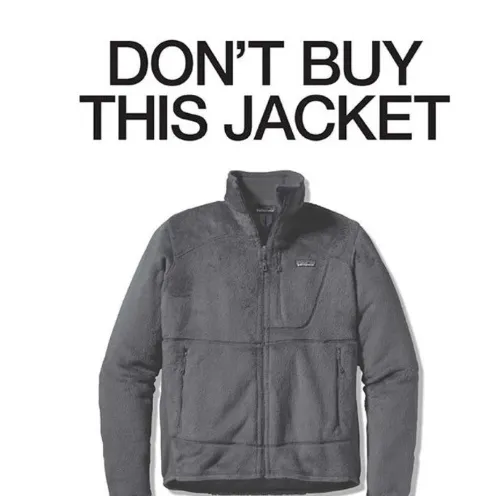
Which is a fairly unusual approach to retail. Patagonia’s famous Don’t Buy This Jacket advert encouraged people to consider whether they actually needed to buy something new. Great advertising, certainly. But the clever bit is that Patagonia didn’t leave the idea in the advertising, it backs it up with its Worn Wear scheme. It repairs products, encourages customers to keep clothing for longer and promotes the reuse and resale of existing Patagonia products. That’s where the brand differentiation becomes much harder to copy – it involves
Any outdoor clothing company can run an advert about sustainability. It’s considerably harder to build a business that actively helps customers avoid replacing the thing you sold them. Patagonia doesn’t just tell people what it believes, it does things that make the belief credible and played out at every touchpoint.
Tony’s Chocolonely – building a brand through product
Tony’s Chocolonely has built something similarly solid and long-standing. Its mission to help end exploitation in cocoa production affects how it sources cocoa, works with farming cooperatives and talks about the chocolate industry – as well as developing their own industry initiative Tony’s Open Chain.
But one of the best expressions of the brand is sitting inside the wrapper. When you break open a Tony’s bar, instead of the usual satisfying grid of identical chocolate squares, it’s all over the place. Big bits, small bits, awkward bits… and it’s deliberate. The unequal pieces mirror inequality and exploitation within the cocoa industry. It’s a tiny detail, but a brilliant bit of brand thinking. The purpose isn’t confined to a paragraph on the website that everybody skips past. It’s built into the actual thing you’re eating.
Product, packaging, sourcing and marketing all tell the same story. A really successful story that has been far harder to tell than a nice purpose statement and a picture of somebody smiling in a cocoa field – yet is far more memorable and resonant.
Ryanair – branding with er… no frills.
Then there’s Ryanair – many people’s least favourite airline. No frills service, and no lofty purpose. There’s no saving the planet, no beautifully worded manifesto about making the world a better place one Boeing 737 at a time. They sell cheap flights, and they sell them their way.
That sounds almost ridiculously simple, but – love Ryanair or hate them – there’s something refreshing about a brand that knows exactly what they stand for. The seats are probably the cheapest you can legally use on an aircraft. You’ll pay for the extras, of which there are many. Their social media team regularly takes the piss out of the things people complain about… but nobody boards a £19.99 flight to Alicante expecting a glass of champagne and a lie-flat bed.
Ryanair made the choice to focus on their bare-bones service, yet also on the cheap fares that allows them to offer. That’s an important part of brand differentiation that sometimes gets overlooked. Being different doesn’t always mean adding more, being better than your competitors in every way or leaping on a bandwagon. Sometimes it means deciding what you’re not going to do; trying to be everything to everybody tends to produce brands that don’t stand for very much at all.
You need something to differentiate
Three completely different businesses with three completely different approaches, yet there’s a common thread. Patagonia has built its environmental position into the essence of what the company does, Tony’s has put its mission into the product and supply chain and Ryanair has built everything around an unapologetically focused commercial proposition.
In each case, the marketing has something real to work with, which is what matters. Distinctive advertising can make a business easier to remember. Great creative, recognisable branding, a character, a catchphrase or even a bloody annoying yodel can all do that rather well. Yet distinctiveness and differentiation aren’t quite the same thing.
Distinctiveness helps people recognise you. Differentiation gives them a reason to choose you.
For businesses thinking of recruiting within brand and product marketing – especially if it is an early-stage hire – that’s an important distinction. The best brand marketers aren’t simply there to make a business look different. They can help identify what customers genuinely value, where a business can credibly differentiate and how that difference should run through the product, proposition and marketing.
Because if your only point of difference is saying you’re different: you’re probably not.